
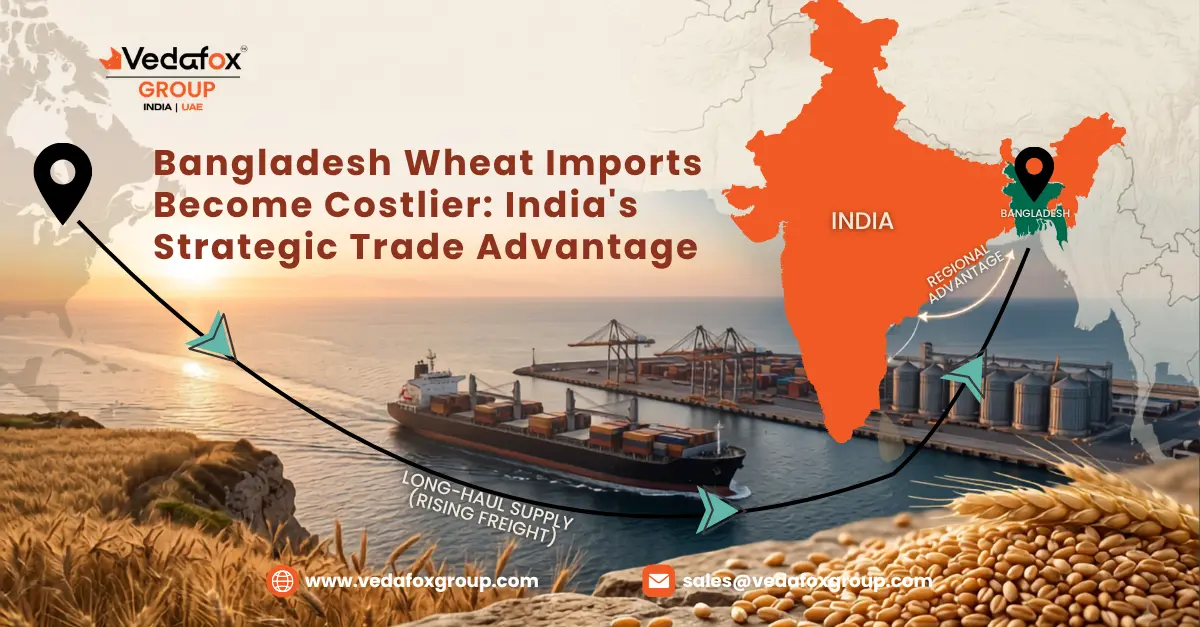
The Changing South Asian Agricultural Trade
Global grain trade is undergoing a structural realignment where geographic distance and maritime security directly dictate landed commodity costs. Bangladesh—one of Asia's largest wheat importers—is experiencing a significant increase in its food import bill. Driven by long ocean transit times, high maritime freight overheads, and geopolitical volatility across traditional sourcing corridors, long-distance procurement is creating severe financial friction for South Asian grain buyers.
Producing only around 13% of its domestic wheat requirement, Bangladesh relies heavily on international markets to bridge an annual supply gap exceeding 7 million metric tonnes. While public and private buyers have diversified sources since 2022, recent purchasing data highlights a widening price disparity between long-haul imports and regional procurement.
This cost gap presents a timely strategic opportunity for Indian agricultural exporters and logistics operators to establish a resilient, short-haul trade corridor.
Bangladesh's Import Cost Disparity: US vs. Black Sea vs. India
Recent public and private procurement transactions in Bangladesh reveal a stark difference in landed grain costs depending on origin and delivery mechanism:
Government-to-Government (G2G) US Wheat: Bangladesh approved the purchase of 220,000 tonnes of US wheat under a G2G agreement at $332 per tonne (with base G2G contract rates ranging between $322 and $332 per tonne).
Open International Tenders: In comparison, 50,000 tonnes purchased simultaneously through an international open tender cost $297.92 per tonne—more than $34 per tonne cheaper than the G2G deal.
Black Sea (Russian) Origin: Baseline Russian wheat offers remain even lower, making US wheat approximately $65 to $70 per tonne more expensive than Russian grain.
Comparative Trade Matrix: Wheat Procurement by Sourcing Origin
Sourcing Origin | Contract Mechanism | Estimated Landed Cost (USD/MT) | Average Transit Duration | Primary Logistical & Financial Profile |
United States | G2G Agreement (USWA MoU) | $322.00 – $332.00 | ~55 Days | High protein quality (13.5%); heavy ocean freight overheads and 55-day capital lockup |
Open International Tender | Competitive Bidding | $297.92 | ~15 – 25 Days | Lowest-price compliance; origin availability fluctuates |
Black Sea (Russia) | Commercial / G2G Trade | ~$260.00 – $270.00 (FOB Base) | ~15 Days | Competitive base pricing; vulnerable to marine insurance surcharges and conflict risks |
India (Regional Corridor) | Overland Rail / Short-Sea | Competitive Regional Pricing | 3 – 7 Days | Direct border clearance, zero ocean freight volatility, minimal working capital lockup |
Sourcing Bottlenecks: Freight Overheads and Black Sea Disruptions
The $65 to $70 per tonne price premium associated with long-haul US wheat is primarily driven by maritime transport logistics:
The 55-Day Transit Window: Shipments from US ports take approximately 55 days to arrive at Bangladeshi ports, compared to 15 days from Black Sea ports. Extended transit times tie up importer working capital, increase financing expenses, and expose buyers to currency fluctuation risks.
Black Sea Security Uncertainty: Russia has historically supplied roughly 55% of Bangladesh's wheat imports. However, growing military tension, drone attacks, and fluctuating war-risk insurance premiums across the Black Sea region continue to create supply uncertainty for Russian and Ukrainian grain.
Surging Private Milling Demand: Private sector importers in Bangladesh purchased 3.25 million metric tonnes of wheat in the first half of FY 2025–26 alone—a 31% year-on-year increase. Private flour millers operating on tight margins cannot easily absorb multi-month transit delays or unpredictable freight surcharges.
Why India is Uniquely Positioned to Fill the Supply Gap
To stabilize domestic food inflation and ensure steady milling inventory, Bangladesh requires reliable, short-haul trade solutions. Re-establishing regular Indian wheat supply flows via overland rail and short-sea trade offers clear logistical advantages:
85% Reduction in Delivery Lead Times: Rail freight moving through Land Customs Stations (such as Petrapole-Benapole, Gede-Darshana, and Radhikapur-Birol) delivers grain from Indian silos directly to Bangladeshi facilities within 3 to 7 days, compared to 55 days from the US.
Elimination of Ocean Freight Volatility: Overland transit bypasses ocean carrier surcharges, port demurrage risks, and global maritime geopolitical bottlenecks.
Working Capital Efficiency: Short lead times allow Bangladeshi millers to buy in smaller, frequent batches, drastically lowering foreign exchange exposure and inventory holding costs.
Frequently Asked Questions
Why are wheat imports becoming more expensive for Bangladesh?
Wheat imports are becoming costlier for Bangladesh primarily due to high maritime freight charges on long-distance routes—such as shipments from the US that take 55 days—and price premiums on G2G contracts ($332/tonne) compared to open competitive tenders ($297.92/tonne). Additionally, security risks in the Black Sea have driven up shipping insurance and logistics fees for regional alternatives.
How much wheat does Bangladesh import annually?
Bangladesh imports between 6.0 and 7.0 million metric tonnes (MMT) of wheat annually, purchasing 6.235 MMT in FY 2024–25. Domestic production meets only about 13% of national demand (~1.22 MMT target), making the country 87% dependent on international grain suppliers.
What structural advantage does India have in supplying wheat to Bangladesh?
India's primary advantage is geographic proximity and integrated land logistics. While US grain takes 55 days and Russian grain takes 15 days by sea, Indian rail cargo reaches Bangladesh in just 3 to 7 days, eliminating maritime shipping surcharges and reducing financial strain on private importers.
Connect With Vedafox Group for Global Trade Execution
Vedafox Group is a multi-industry export conglomerate headquartered in India with international operations in Dubai. Combining multi-industry expertise with global logistics networks, Vedafox Group helps businesses navigate cross-border supply chains with consistency and precision.
Contact Our Trade Management Team:
Corporate Headquarters (India): Mumbai, Maharashtra, India
International Office (Dubai): Vedafox Ventures FZ-LLC, Ras Al Khaimah Economic Zone (RAKEZ), UAE
Phone & WhatsApp Business: +91 9820-999-221
Official Trade Email: sales@vedafoxgroup.com
Website: www.vedafoxgroup.com